

For years, frequency response was the revenue foundation for battery storage and commanded a premium. But as more batteries have entered the same shallow markets, that premium has eroded; in Great Britain, frequency response fell from 87% of battery revenue in 2020–2022 to roughly a third today1. S&P Global sees the same across major markets: as these services saturate, revenue has shifted toward energy arbitrage instead2.
Asset owners are now learning that revenue mix will keep shifting over a 20-year life, and the projects that stay profitable are those capable of earning from several markets at once and moving nimbly between them as conditions change. What makes that possible: the orchestrating software. This article breaks down how concurrent, multi-mode dispatch works, the value it unlocks in each service category, and how to tell whether your current platform can deliver it.
Multi-Mode vs. Single-Mode Dispatch
It’s important to note that single-mode EMS platforms weren’t designed poorly; they were designed for a different market, one where a single service dominated project economics. In the current market, single-function architecture becomes a liability: early-mover advantages in any one service erode as more assets compete for the same revenue. The ability to value-stack is highly dictated by market-specific participation rules, and portfolios that can rotate across services are structurally insulated from that compression in ways that single-mode assets aren’t3.
Effective multi-mode dispatch requires an EMS that can run control functions concurrently — resolving conflicts between modes in real time and transitioning between states without creating grid disturbances. That software can unlock value across each service category of frequency management, voltage management, power management, and system control.
Frequency Management
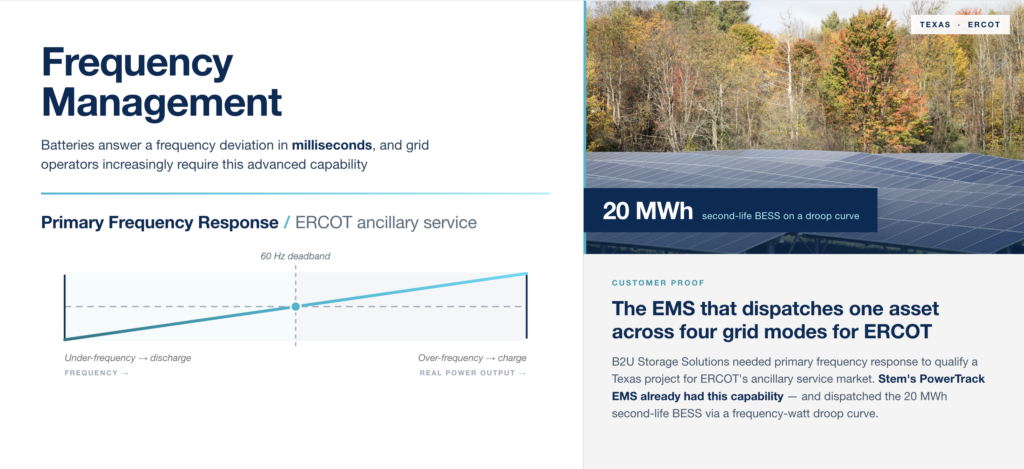
Frequency management remains the area where batteries have a physical advantage nothing else can match: no conventional generator responds to grid deviations in milliseconds. Grid operators pay a premium for that capability, and regulators are increasingly making it a condition of connection:
- In Europe, the draft amendment to its grid-connection code (NC RfG 2.0), now with the European Commission for adoption, is expected to make grid-forming capability — defined by ENTSO-E as voltage-source behavior with inertial active-power response, fault-current contribution, and oscillation damping—a binding interconnection requirement for new storage above 1 MW4 depending on synchronous area.
- In Australia, batteries of 5 MW or greater have been required to provide primary frequency response whenever dispatched since June 2025, and projects that don’t propose grid-forming capability now face connection delays, penalties, or rejection5 6.
- In North America, NERC’s tightening compliance framework — including MOD-026-2, effective April 2026 — requires battery owners to verify frequency and voltage control performance, with penalties of up to $1.54M per day per violation7.
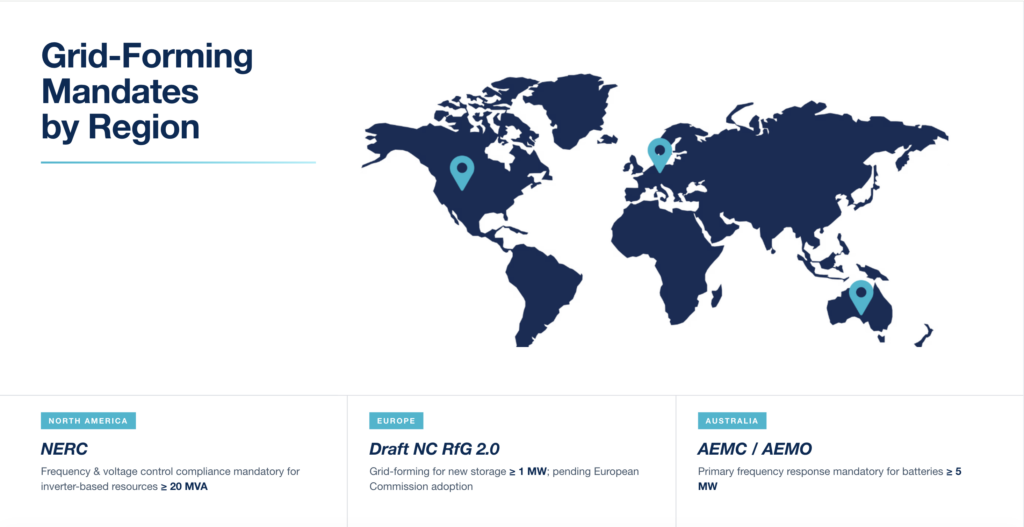
The revenue opportunities and compliance obligations are converging. For new projects in most major markets, frequency management is becoming a baseline requirement for connecting at all, and therefore accessing all other revenue streams.
Control Modes
- Fast Frequency Response (FFR): Reacts within a sub-second to stabilize the grid ahead of conventional generation, earning FCR revenue in Continental Europe and the Nordics, plus dedicated fast-response products—Nordic FFR and GB Dynamic Containment—and capacity payments and enhanced interconnection terms in North America.
- Frequency Watt Control: Continuously adjusts active power output based on grid frequency, running as a background function alongside other dispatch instructions — adding primary frequency response revenue without displacing other services.
- Power Oscillation Damping: Detects and counters grid oscillations in real time, supporting connection compliance. This is an increasingly a hard interconnection requirement from European transmission system operators.
Together, these modes generate revenue continuously — not just during discrete dispatch events — while improving the grid behavior that determines interconnection capacity and long-term curtailment exposure.
In practice
Voltage Management
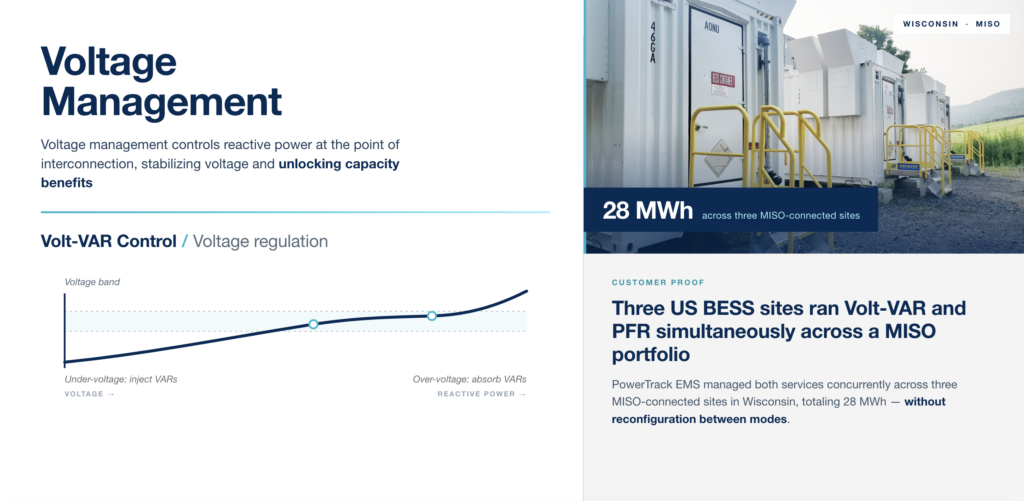
Voltage Management captures a revenue stream that most asset owners aren’t fully accounting for in their financial models, and increasingly, it’s also a compliance baseline. Reactive power capability has shifted from an optional feature to a mandatory interconnection requirement for battery storage in most major markets8, with NERC MOD-026-2 (the same standard covering frequency control) requiring field-validated voltage control performance for US assets above 100 kV, effective April 20269.
Control modes
- Automatic Voltage Regulation (AVR) maintains voltage at the point of interconnection through continuous reactive power adjustment, supporting enhanced interconnection capacity terms and reducing the risk of forced curtailment during voltage events.
- Volt-VAR Control dynamically compensates reactive power based on real-time voltage levels, improving power factor and interconnection compliance— a direct margin improvement that doesn’t depend on market prices.
- VAR Control provides steady-state reactive power support at specific network locations. In Continental Europe, this is typically an unpaid connection obligation rather than a revenue source; in markets where it is compensated, it can be structured as a long-term contracted service with predictable revenue, distinct from more volatile merchant services.
For portfolios with significant merchant exposure, contracted reactive power revenue provides a useful counterbalance, and one that compounds in value as energy price volatility increases.
In Practice
Power Management
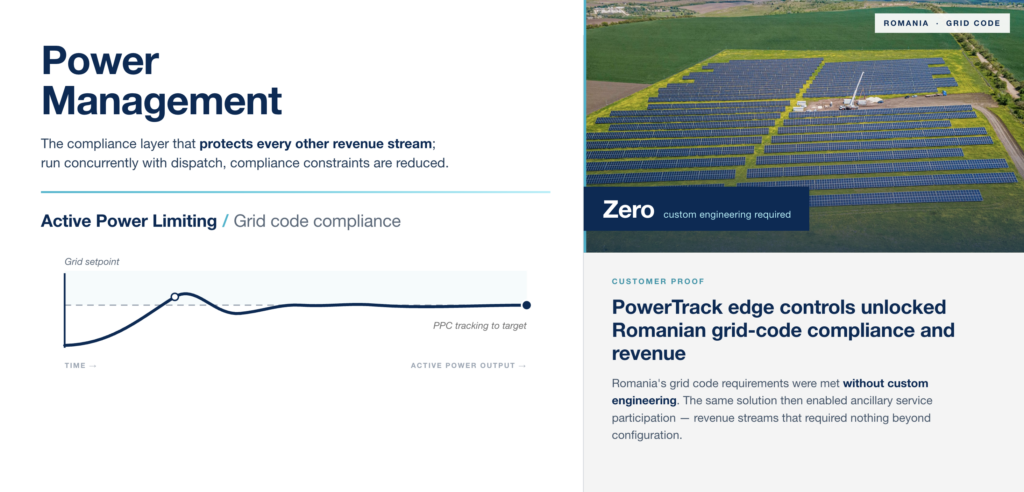
Power Management governs the compliance obligations that protect every other revenue stream. These aren’t new regulatory mandates in the way that frequency and voltage requirements are, but failure here has the same practical consequence: market exclusion, interconnection penalties, or forced curtailment that erodes gains from everything else.
Control Modes
- Automatic Frequency Restoration Reserve (aFRR) / Regulation: participates in secondary frequency control by following automated dispatch signals. In Europe, this is procured as aFRR through tendered capacity and/or energy auctions; in North America, the naming varies but the underlying concept is similar.
- Active Power Limiting: Caps active power output to manage grid constraints and interconnection agreement requirements, protecting capacity factors and avoiding the penalties that follow non-compliance.
- Fixed Power Factor: Maintains constant power factor by balancing active and reactive power output, reducing penalties and supporting interconnection terms.
Individually, these are compliance functions. Running them concurrently with revenue-generating modes is what prevents compliance from becoming a constraint on dispatch.
In Practice:
System Control
In this layer, multi-mode dispatch compounds across the full portfolio. The modes here don’t generate revenue directly, but they determine how well every other mode performs, and how much of the available market value the asset actually captures.
Control Modes
- Dynamic SOC Control optimizes state of charge against forecasted prices, grid conditions, and upcoming system constraints — positioning the asset to maximize value from each committed service rather than reacting to price signals after the fact. In North America, this enables simultaneous optimization across energy and ancillary services. In Europe, it coordinates day-ahead, intraday, and ancillary service participation within a single dispatch framework.
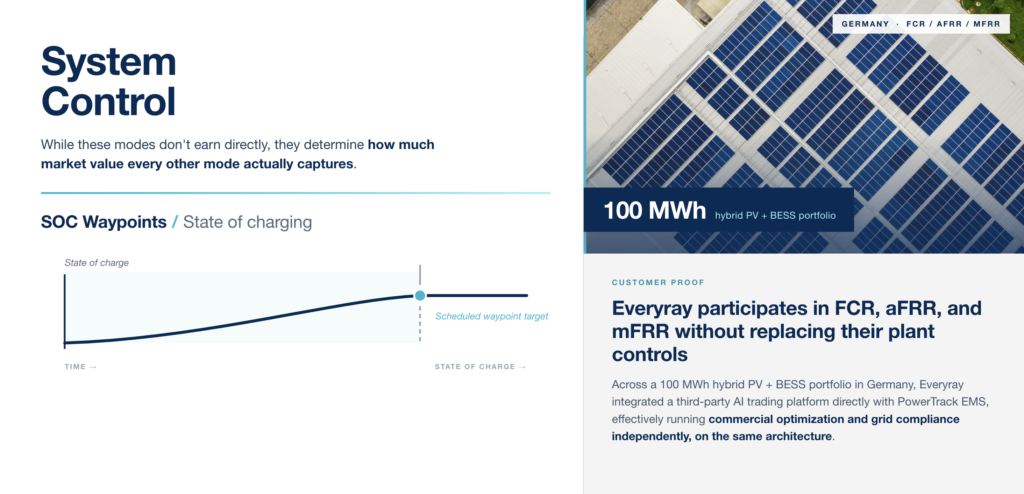
- SOC Waypoints enables precise state-of-charge targeting at scheduled future times, reducing market penalties and improving day-ahead bidding accuracy when projects carry performance guarantees or contracted delivery obligations.
For commercial managers, this is the layer that closes the gap between what a revenue model projects and what the asset actually delivers.
In Practice
Understanding the Compounding Benefits of Multi-Mode Dispatch
Each mode delivers value independently, so the financial case for multi-mode dispatch is that they compound.
Voltage regulation can run continuously while the system follows an arbitrage schedule and maintains frequency response readiness. A reactive maintenance event in one service doesn’t pull the asset offline from all others. And when a specific market saturates — which is an inherent risk as more single-function assets compete for the same revenue — an asset with concurrent multi-mode capability can rotate to adjacent services without hardware replacement or extended recommissioning.
For commercial managers modeling project revenue, the difference is the basis of the projection: a single-service floor versus a multi-service composite that reflects what the asset is actually capable of earning. For investors underwriting long-duration assets, it reduces platform risk as market structures evolve. An EMS that required a firmware cycle to access a new market in year one will require the same in year six — and the EMS vendor’s roadmap, not your commercial team’s judgment, determines when that happens.
Questions to Assist Your EMS Evaluation
When evaluating an EMS, ask the revenue stacking question to cut through the noise: can the EMS run multiple control modes simultaneously, with automatic conflict resolution, without taking the system offline to switch between them?
A platform that doesn’t (or redirects to a feature roadmap) is a single-function system with multi-function aspirations. As demonstrated, those differences result in different significant implications over a 20-year asset life.
PowerTrack EMS’s 12 control modes reflect operational requirements and draw on Stem’s deployment history: 800+ BESS sites in more than 50 countries. Concurrent execution and bumpless mode transitions are engineering priorities shaped by what it actually takes to operate storage assets across diverse regulatory environments, at scale, over time.
Remember: the revenue that multi-mode dispatch unlocks is available now. Every month of operation on a single-function platform is revenue the asset is physically capable of generating—but isn’t.
To learn how PowerTrack EMS can expand the revenue profile of your assets, contact our team at [email protected] (North America) or [email protected] (EMEA), or explore PowerTrack EMS.
2 https://www.spglobal.com/energy/en/news-research/blog/energy-transition/110625-declining-costs-shifting-revenues-evolving-business-case-for-battery-storage
3 https://www.macquarie.com/us/en/about/company/macquarie-asset-management/institutional/insights/battery-storage-strategies-for-revenue-stacking-and-investment-success.html
4 https://www.pv-magazine.com/2025/11/12/europe-to-require-grid-forming-capability-for-new-storage-above-1-mw/
5 https://www.energy-storage.news/australias-grid-forming-battery-storage-pipeline-extends-to-nearly-a-hundred-projects-says-aemo/
6 https://www.energy-storage.news/aemo-to-streamline-nem-connection-standards-for-generators-and-bess-in-australia/