

The NJ Storage Playbook – Part 2
When New Jersey’s Garden State Energy Storage Program (GSESP) Phase 2 officially launches this summer, the conversation among commercial, industrial, and municipal energy customers will shift quickly from whether to invest in behind-the-meter (BTM) storage to how much it’s actually worth.
The answer is more nuanced and more compelling than most customers expect.
A well-structured BTM battery project in New Jersey doesn’t derive its value from a single incentive; its value comes from a stack of revenue streams that, when optimized together, can fundamentally change a project’s economics.
Understanding that stack, as well as how each layer interacts with each other, is the difference between a project that pencils and one that doesn’t.
The GSESP Phase 2 Foundation
Phase 2 is expected to offer two distinct incentive mechanisms:
- A fixed capacity payment, expressed in dollars per kilowatt-hour ($/kWh) of enrolled storage, paid out in equal annual installments over a multi-year term.
- A performance-based payment tied to dispatch events issued by the customer’s electric distribution company.
- This payment varies by utility territory and system performance, giving customers an ongoing incentive to maintain high dispatch accuracy throughout the program term
The fixed incentive is locked in at the time of application and awarded on a first-come, first-served basis within annual capacity blocks. This is why we emphasized in our previous article, “The NJ Storage Playbook: Inside GSESP Phase 2 and Beyond Part 1,” that preparation before the portal opens is essential.
Final rates, payout terms, and call structures remain dependent on the upcoming BPU order expected this summer, but even in a conservative scenario, the GSESP incentives alone represent a meaningful contribution to project returns.
The PJM Layer: Where New Jersey Projects Get Interesting
What separates this opportunity in New Jersey from similar programs in other states is the PJM market context.
New Jersey customers face some of the highest capacity and transmission charges in the country And BTM storage is uniquely positioned to address them.
PJM determines each customer’s annual capacity obligation based on their measured load during the five highest coincident peak hours across the entire PJM footprint, a metric known as the Peak Load Contribution (PLC) tag.
For a customer with meaningful load during those five hours, the ability to discharge a battery and reduce their tag translates directly into substantial annual savings.
Transmission costs follow a similar logic. The Network Integration Transmission Service (NITS) rate, which determines what customers pay for transmission, is based on a customer’s coincident demand during peak periods within their utility zone. PSEG customers, in particular, face among the highest NITS rates in the PJM footprint, making transmission tag mitigation a significant value driver in that territory.
Importantly, capacity and transmission peaks often overlap, which means a single dispatch event can simultaneously reduce both tags: two value streams from one battery action.
Rounding Out the Stack
Beyond GSESP and PJM tag-mitigation, two additional streams contribute meaningfully to project economics: frequency regulation and synchronized reserves, PJM’s wholesale ancillary services.
Customers with BTM storage can access this ancillary services market through a Curtailment Services Provider; meaning that, on days when the battery isn’t committed to a peak event or performance call, those hours can be bid into the wholesale market by a Provider for additional revenue.
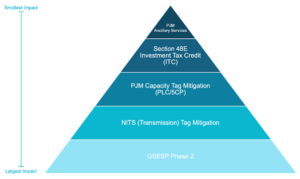
And for C&I customers pursuing direct ownership or third-party financing structures, the Section 48E Investment Tax Credit remains available, reducing the project’s capital cost basis by 30%. That reduction has a compounding effect on overall returns, improving payback period across every other revenue stream in the stack.
The Dispatch Problem
Stacking these revenue streams on paper is relatively straightforward, but operating them simultaneously is not.
Each stream has different dispatch requirements, timing windows, and performance metrics, making operation complex.
Missing a coincident peak or dispatching a battery at the wrong time can erode savings that would have been central to the project’s financial case.
The operational complexity of a fully stacked NJ storage project is significant, and it’s where the difference between a capable optimizer – who can coordinate forecasting, real-time decision-making, and a dispatch architecture that can resolve conflicts between competing value streams as they happen – and a basic controls system becomes obvious and material.
What This Means Before the Order Drops
The BPU order this summer will lock in the GSESP rates and program mechanics. Before that happens, the most important thing a customer can do is understand how their specific load profile, utility territory, and ownership structure interact with each layer of the value stack that was discussed above.
Not every customer will benefit equally from every stream, but modeling your project size, dispatch strategy, and financing structure now – before the blocks open – is what separates customers who capture the best economics from those who don’t.
Stem’s advisory team is actively supporting C&I, municipal, and public power customers in New Jersey with scenario-based financial analysis ahead of the GSESP Phase 2 order.
Want to learn more?