
4 Key Insights from Stem’s Director of Technical Product Management
The energy industry has hit an inflection point. Gigawatts of battery assets are now years into operation, and the data is clear: the decisions made at installation define what’s possible a decade later. The best-performing portfolios didn’t get lucky, they were designed and managed with the long game in mind.
Battery energy storage systems (BESS) come with big promises — but what actually breaks down in the field, and what does the industry need to do differently? Stem’s Director of Technical Product Management, Sam Kuhlwein, shares key takeaways for energy storage project developers and owners looking to maximize asset longevity and revenue from the start.
#1: The most expensive maintenance approach is “wait and see.”

Too many operators are still running reactive maintenance programs: waiting for something to fail before doing the work. For storage, such an approach is financially reckless. A critical failure can mean extended downtime during peak dispatch windows, degraded warranty positions, and replacement costs that dwarf what a preventative program would have cost over years. The assets that stay online generating revenue are those with structured preventative maintenance programs and consistent site health monitoring, not those reacting to alarms after the fact.
Data visibility is inseparable from proactive maintenance programs. Operators without granular, real-time insight into their systems are making a dangerous risk bet, usually without realizing it.
Key takeaway: A reactive maintenance program isn’t a cost-saving measure. Over a full asset lifecycle, it’s one of the most expensive choices an operator can make. Employ a proactive preventative maintenance program or ask your vendors what capabilities they have to ensure real-time visibility and planning.
#2: BESS thermal management is an intersection where hardware problems become software problems

BESS thermal management sits at the overlap of original equipment manufacturer (OEM) responsibility and operator responsibility, and that boundary is where we’ve seen things fall apart.
It’s true the battery management system (BMS) and HVAC controls are primarily the OEM’s domain. But an energy management system (EMS) has a critical role that’s often underutilized: using temperature data to derate power requests before conditions become dangerous, and surfacing alarm states to operators early enough to actually act on them. When that loop breaks and alarms aren’t reaching the right people in time, a manageable thermal event becomes a hardware failure. Thermal failures are usually a monitoring and response problem that hardware ends up taking the blame for.
Key takeaway: Good thermal outcomes depend on the full stack working together. OEM controls set the floor; EMS configuration and operator responsiveness determine whether you stay above it. Before commissioning, work with your EMS provider to establish clear alarm escalation protocols and automated derating logic.
#3: Performance and availability data are the records that win or lose expensive operational disputes
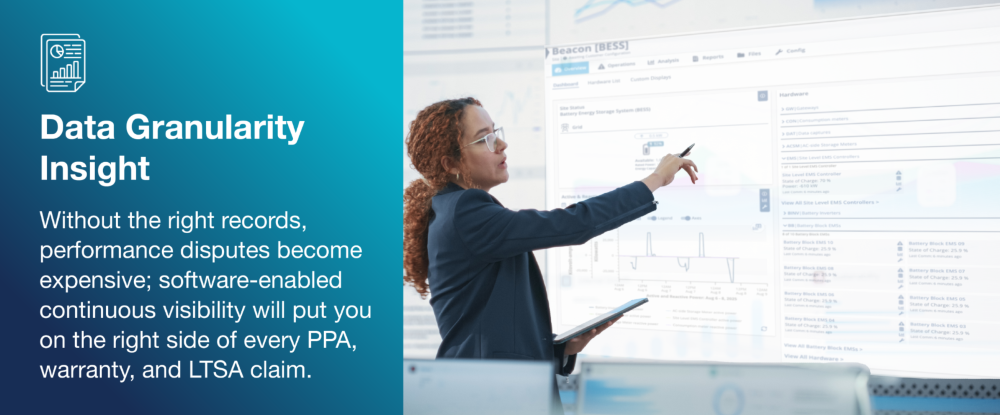
Most operators don’t treat data granularity and frequency as a priority until they’re in a dispute they can’t win. Planned purchase agreement (PPA) true-ups, warranty claims, and long-term service agreement (LTSA) negotiations all hinge on the ability to reconstruct exactly what the system did and when. Without the right data architecture, asset owners end up on the wrong side of expensive contractual situations with no way to make their case.
From a software standpoint, getting there means capturing data at the right frequency, structuring it for the calculations that matter, and making performance and availability metrics continuously visible rather than something you reconstruct after the fact when a claim is already on the table.
Key takeaway: Data granularity isn’t just an operational nice-to-have. It’s the evidentiary record that determines who wins in a PPA true-up, warranty dispute, or LTSA claim. If possible, define your data requirements by working backward from your contractual obligations before a project reaches commercial operation.
#4: Take the long view: Year one decisions determine your capability (and revenue) in year ten

Asset owners almost universally underinvest in data strategy and see the painful results at augmentation time.
Without granular operational data from the start, augmentation decisions get made without knowing how the system actually degraded under its real-world dispatch profile, or whether the remaining capacity build is appropriately sized for the asset’s remaining life. Those are multi-million dollar decisions made on incomplete information.
The operators who get this right are those who treat data strategy as infrastructure from the very start. They instrument their systems for the questions they’ll need to answer in year eight or year twelve. Granular, continuous operational data becomes the evidentiary foundation for every capital decision over the asset’s life.
Key takeaway: Augmentation decisions are only as good as the data behind them. The time to build that foundation is at commissioning, not when you need it. Treat your data strategy with the same rigor you’d apply to equipment procurement; the operators making better augmentation decisions started collecting the right data earlier and built a foundation that compounds in value over the life of the asset.
The bottom line
The BESS assets that perform over a 15 to 20 year lifecycle are the ones with the best operational discipline: preventative maintenance programs, responsive thermal management, and a data strategy built for the long term. In modern storage operations, software and analytics are the O&M strategy.
See how Stem’s PowerTrack Suite approaches fleet-wide BESS monitoring and lifecycle management.