
Executive summary: Traditional PV controllers lack battery dispatch logic while BESS systems treat solar as an external variable; this post explores how hybrid control architectures enable real-time coordination, maximizing grid service value and unlocking multiple revenue streams.
In our second series post, we examined how fragmented control architectures create interconnected challenges in hybrid projects. Our previous, third post explored multivendor coordination—how conflicting control philosophies between photovoltaic (PV) manufacturers, battery energy storage system (BESS) suppliers, and grid operators stretch integration timelines and create persistent performance issues.
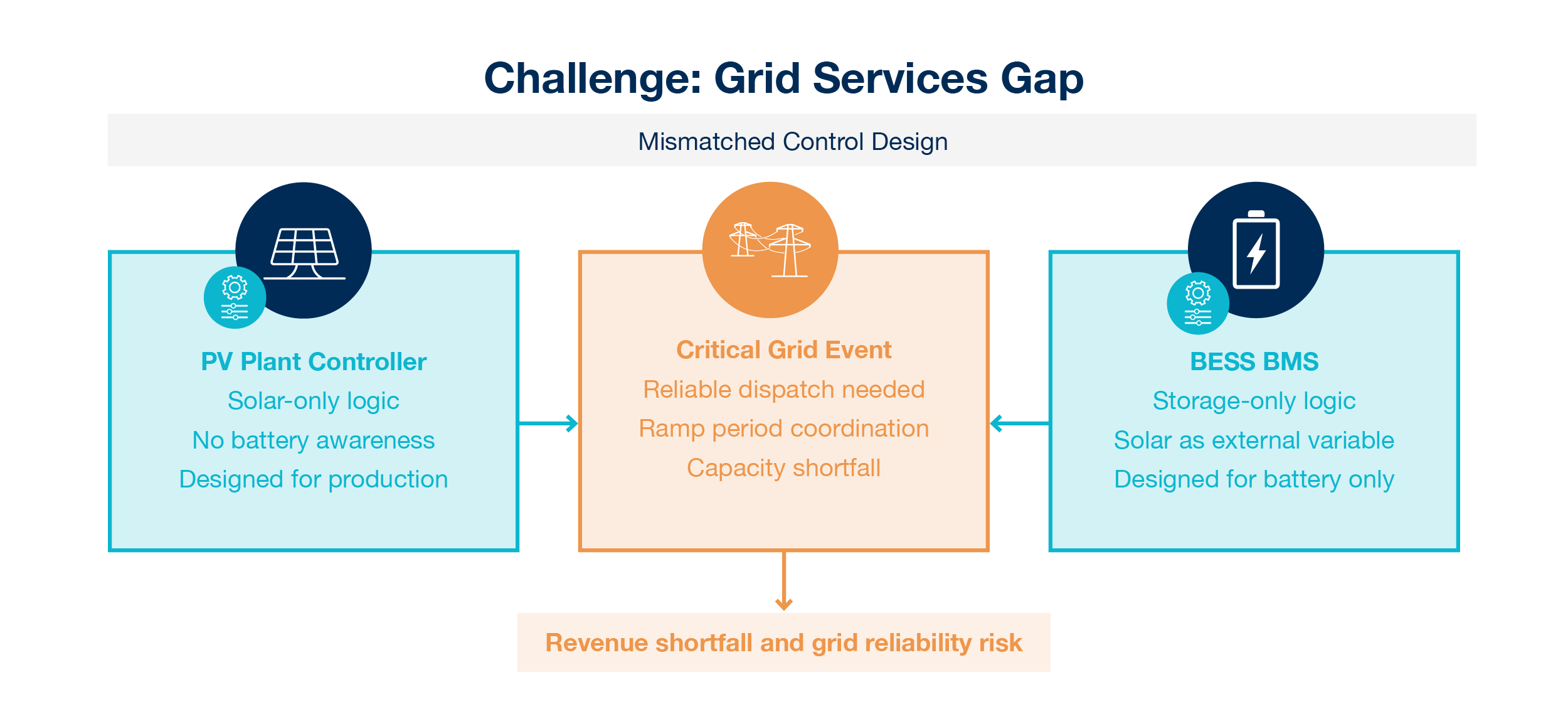
But even when you successfully coordinate multiple vendors, there’s a deeper problem: the control systems themselves weren’t designed for hybrid assets. Traditional PV plant controllers optimize for production without understanding battery constraints. BESS energy management systems treat solar generation as an external variable they can’t control. Neither was built to deliver grid services that require real-time coordination between both resources.
Challenge
Grid Services Gap
Mismatched Control Design
Traditional PV plant controllers were designed for solar-only assets and lack the logic to coordinate battery dispatch, while BESS energy management systems treat solar generation as an external variable rather than an integrated resource. Neither system was built to optimize a hybrid asset delivering grid services like frequency response. The result is poor coordination when performance matters most—during critical grid events like shortfalls or ramp periods.
Impacts
Revenue Loss and Grid Reliability Risk
Poor coordination manifests in multiple ways: the asset may fail to enforce zero net export requirements during curtailment periods, miss opportunities to charge the battery with excess PV production that would otherwise be wasted, or be unable to stack grid services with energy arbitrage when both revenue streams are available. Compromised grid service delivery translates directly to missed revenue opportunities, whether through reduced capacity payments, failed performance tests, or inability to capture high-value ancillary service markets. Repeated, unaddressed underperformance puts the asset at risk of curtailment or removal from grid service programs.
Solution Framework
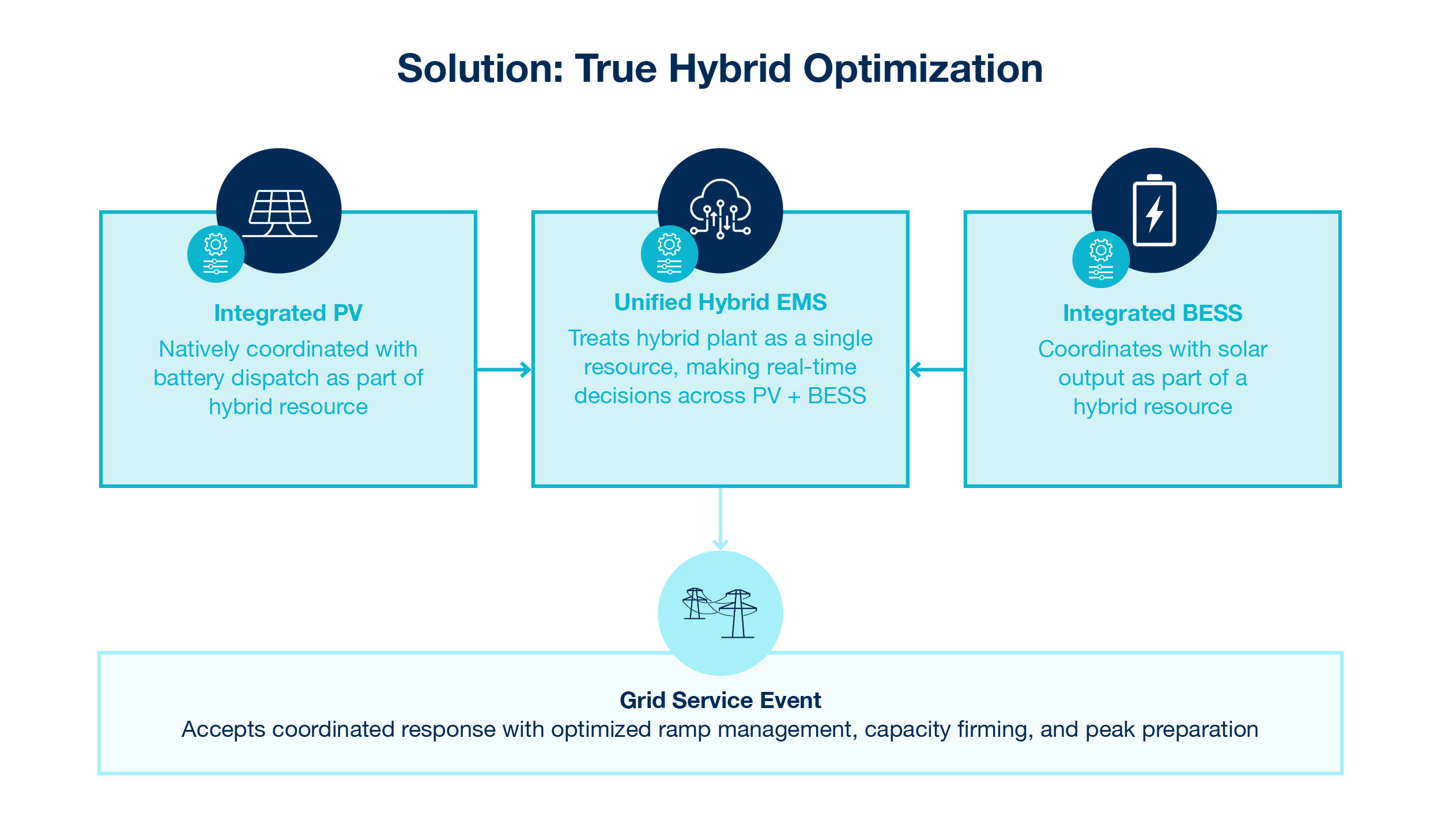
True Hybrid Optimization
Holistic asset control treats the hybrid plant as a single resource—not two independent systems that happen to share a grid connection. An EMS can make real-time decisions that account for current solar output, forecasted generation, battery state of charge, and grid service commitments simultaneously. This capability then enables intelligent tradeoffs, like reserving battery headroom during morning ramp periods or pre-positioning stored energy ahead of evening peak.
Key Benefits
Maximized Grid Service Value
Real-time coordination unlocks revenue opportunities, like higher performance scores in ancillary service markets. The system can respond to grid signals with the full flexibility of both resources and is not limited by whichever control system happens to receive the dispatch command. Over time, the project will receive higher asset utilization and revenue capture across multiple value streams.
Key Takeaways & Recommendations for Developers
Assess hybrid capability beyond vendor marketing claims by:
- Asking how the proposed EMS handles real-time tradeoffs between solar generation and battery dispatch; request specific examples
- Verifying the system can pre-position energy based on forecasted solar output and grid service commitments, not just react to current conditions
- Evaluating whether the control logic was purpose-built for hybrid assets or retrofitted from standalone solar/storage platforms
- Requesting performance data from existing hybrid projects showing grid service delivery scores during critical events (ramps, frequency deviations, peak periods)
Next up: We’ve seen how multivendor coordination and mismatched control design prevent hybrid assets from delivering full grid service potential. But there’s a more time-sensitive issue: control signal latency. In our next post, we’ll examine how fragmented control layers introduce delays that cause assets to fail fast frequency response qualification tests—not because the hardware can’t perform, but because the architecture is too slow.