
Executive summary: Making control architecture decisions late in hybrid solar-plus-storage project development, or treating them as procurement details rather than strategic choices, forces developers to accept compromised performance and revenue erosion. This concluding article provides a practical framework for evaluating architecture options when they can still optimize project value.
The Interconnected Challenge
Over this series, we’ve explored how control architecture choices create cascading impacts:
- Multivendor coordination can stretch integration from weeks into months as conflicting control objectives create consistent performance issues that reduce availability and degrade grid service delivery. Integration delays push commercial operation dates and directly erode project NPV, while ongoing coordination gaps create operational overhead that persists throughout the asset’s life.
- Grid services gaps emerge when traditional PV controllers lack battery dispatch logic while BESS systems treat solar as an external variable; neither is built to deliver grid services requiring real-time coordination between both resources. Assets fail to enforce zero net export requirements, miss opportunities to capture excess PV production, and compromise grid service delivery during critical events, translating to missed revenue opportunities and reduced capacity payments.
- Control layer complexity introduces latency at each handoff between separate EMS and PPC systems, causing assets to fail fast frequency response qualification tests, not because the hardware can’t perform but because the architecture is too slow. Projects that were budgeted for fast response revenue streams can’t qualify for services they may have been designed to provide, and excessive latency leads to slower responses and reduced service payments under performance-based contracts.
These aren’t isolated problems. Multivendor coordination issues amplify latency concerns; grid service gaps multiply with each additional communication interface. All three result from fundamental architecture decisions that shape whether projects can deliver on their projected performance.
Solution Framework: Four Questions for Control Architecture Evaluation
The path forward requires evaluating architecture options during early project development, when choices can still optimize rather than merely accommodate project constraints.
Four questions to ask for control architecture evaluation

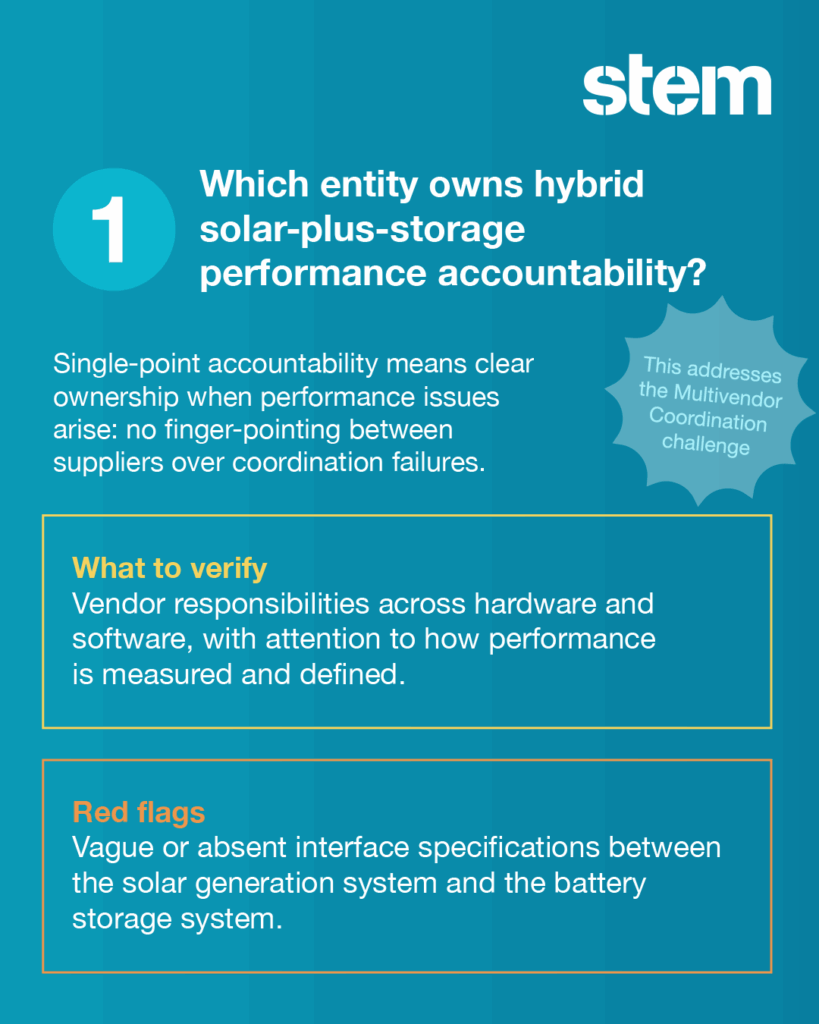
1) Which entity owns hybrid solar-plus-storage performance accountability?
Single-point accountability means clear ownership when performance issues arise: no finger-pointing between suppliers over coordination failures.
What to verify: Vendor responsibilities across hardware and software, with attention to how performance is measured and defined.
Red flags: Vague or absent interface specifications between the solar generation system and the battery storage system.
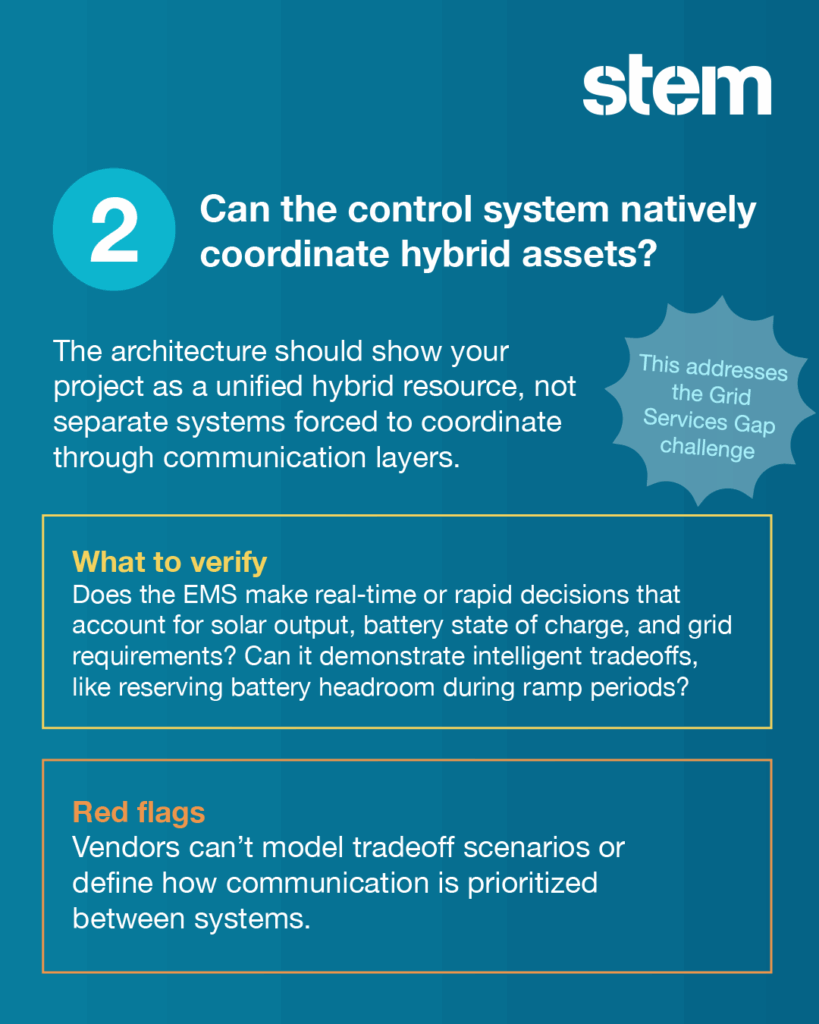
2) Can the control system natively coordinate hybrid assets?
The architecture should show your project as a unified hybrid resource, not separate systems forced to coordinate through communication layers.
What to verify: Does the EMS make real-time or rapid decisions that account for solar output, battery state of charge, and grid requirements? Can it demonstrate intelligent tradeoffs, like reserving battery headroom during ramp periods?
Red flag: Vendors can’t model tradeoff scenarios or define how communication is prioritized between systems
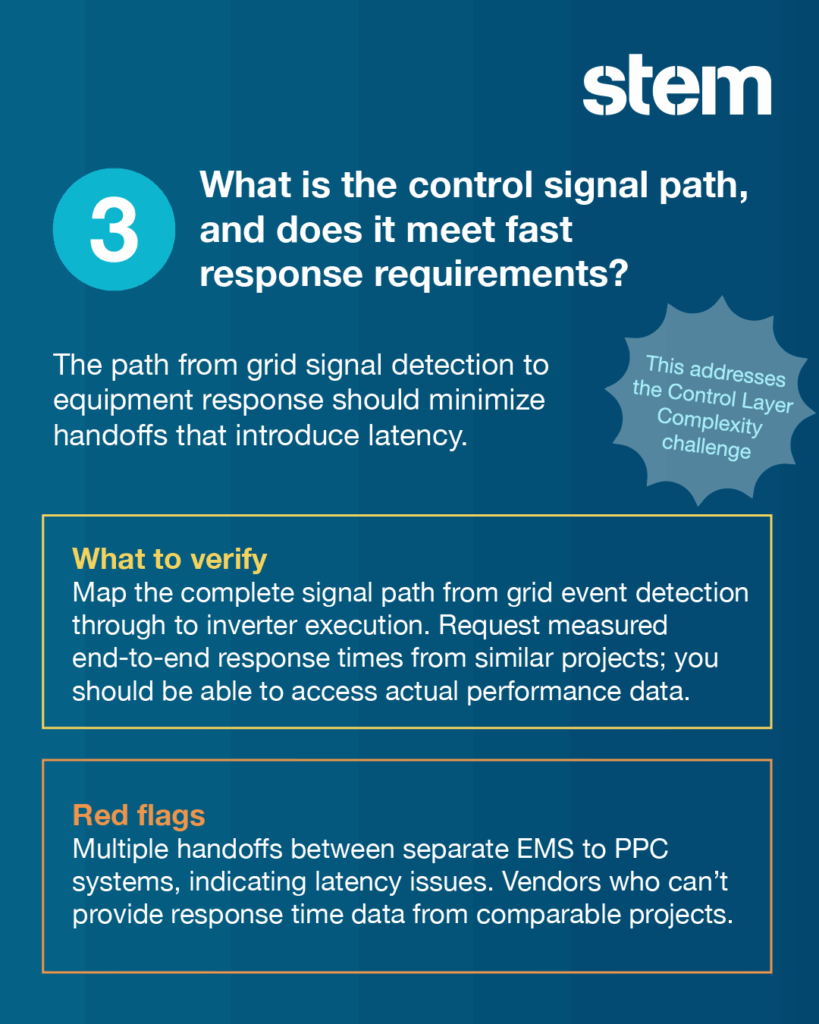
3) What is the control signal path, and does it meet fast response requirements?
The path from grid signal detection to equipment response should minimize handoffs that introduce latency.
What to verify: Map the complete signal path from grid event detection through to inverter execution. Request measured end-to-end response times from similar projects; you should be able to access actual performance data.
Red flags: Multiple handoffs between separate EMS to PPC systems, indicating latency issues. Vendors who can’t provide response time data from comparable projects.
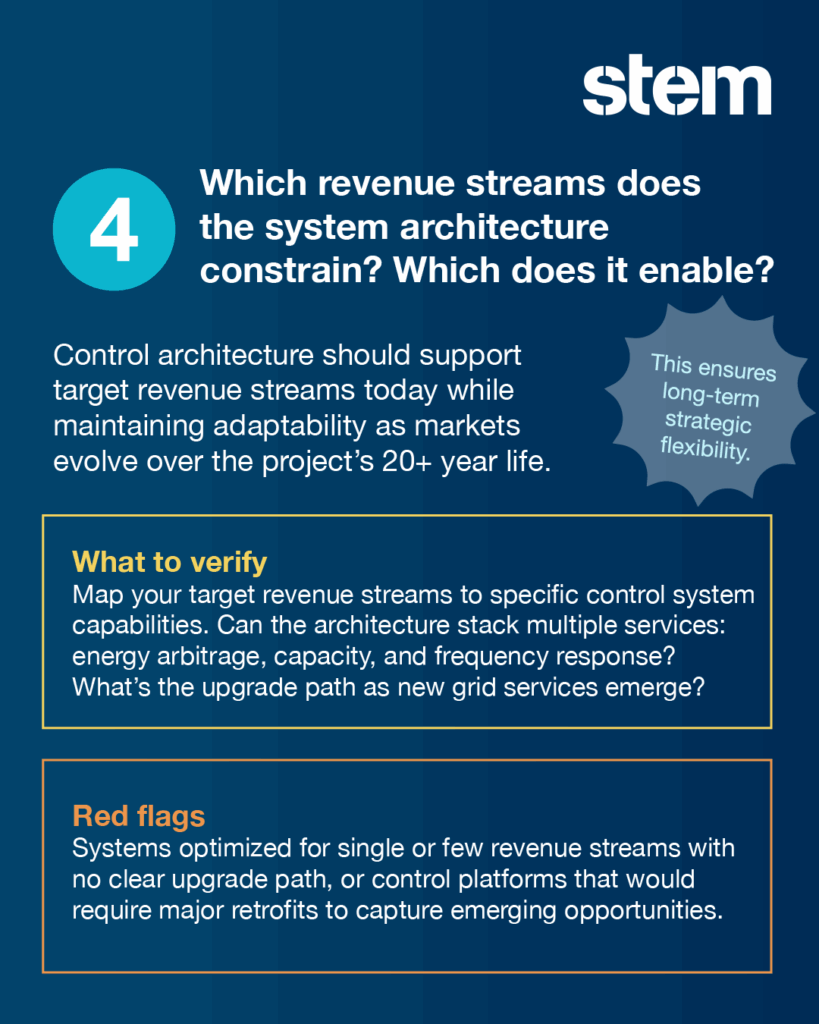
4) Which revenue streams does the system architecture constrain? Which does it enable?
This ensures long-term strategic flexibility. Control architecture should support target revenue streams today while maintaining adaptability as markets evolve over the project’s 20+ year life.
What to verify: Map your target revenue streams to specific control system capabilities. Can the architecture stack multiple services: energy arbitrage, capacity, and frequency response? What’s the upgrade path as new grid services emerge?
Red flags: Systems optimized for single or few revenue streams with no clear upgrade path, or control platforms that would require major retrofits to capture emerging opportunities.
Key Benefits: From Reactive to Proactive Development
When control architecture evaluation happens early during development, projects are more likely to achieve on-time commissioning, bankable revenue projections, improved operational efficiency, and strategic adaptability. Systems designed for coordination from the start eliminate the integration delays, performance gaps, and troubleshooting that negatively impact fragmented control architectures.
Key Takeaways & Recommendations for Developers
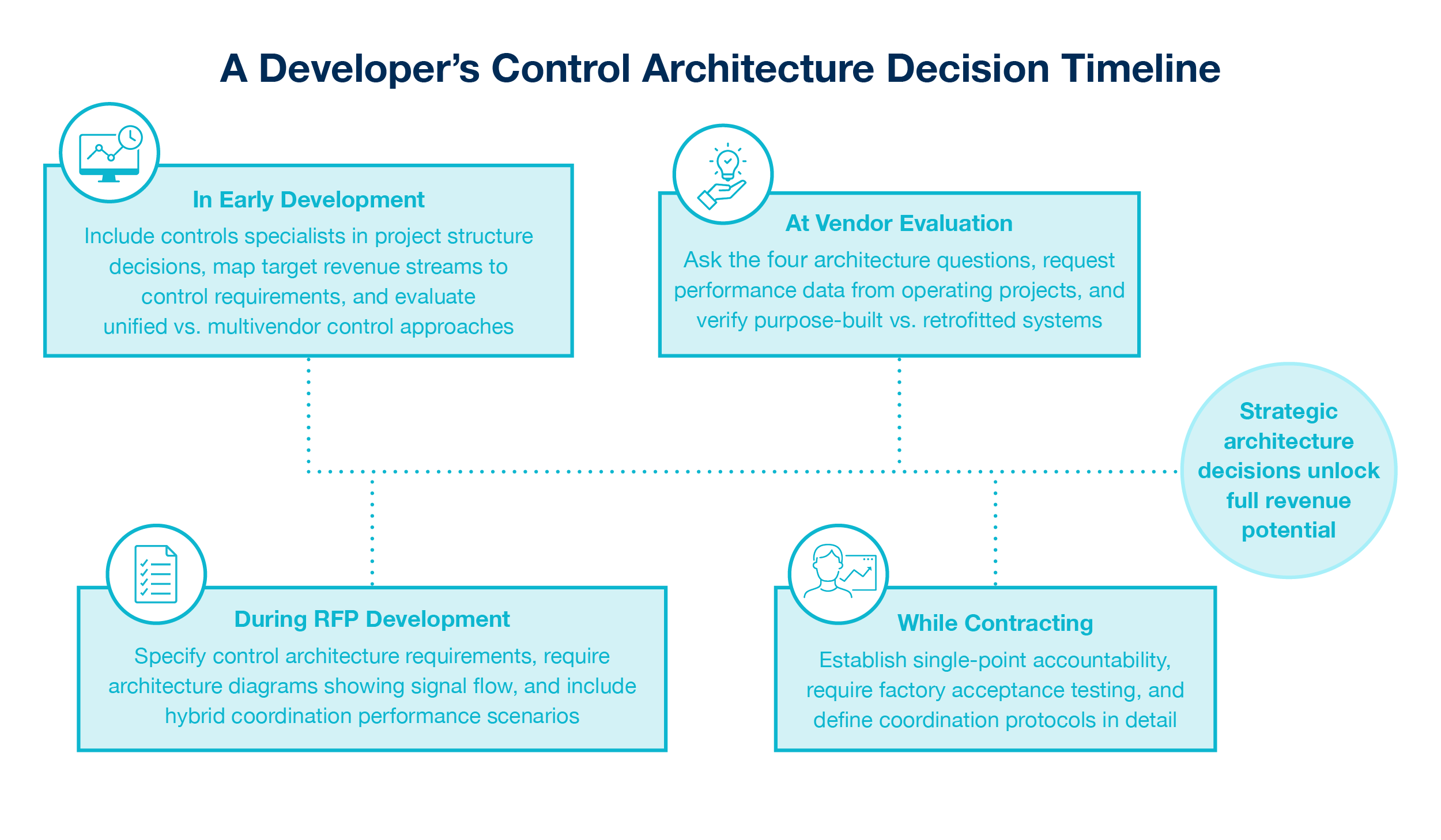
During early development
- Include controls specialists early in project structure decisions before finalizing architecture approaches
- Map target revenue streams to control system requirements, clarifying which capabilities are essential
- Evaluate whether unified hybrid control or coordinated multivendor systems match your revenue strategy
In RFP development
- Specify control architecture requirements, not simply functional capabilities
- Include performance scenarios testing hybrid coordination during critical grid events and conflicting setpoints
- Require architecture diagrams that demonstrate signal flow from grid events through equipment response
At vendor evaluation
- Ask the four questions in the above solution framework with detailed examples
- Verify whether proposed systems are purpose-built for hybrid assets or retrofitted from standalone platforms
While contracting
- Establish single-point accountability for hybrid system performance with clear coordination requirements
- Require factory acceptance testing that include end-to-end response scenarios
Conclusion
The three challenges we’ve examined over the course of this series (multivendor coordination, grid services gaps, and control layer complexity) aren’t inevitable. They’re consequences of architecture decisions that are often made during early project development and are often made by default rather than through strategic evaluation. Those who implement fragmented systems will struggle to qualify for high-value services, miss dispatch opportunities during critical pricing events, and face costly retrofits (or permanent performance constraints) as they attempt to adapt to evolving markets.
The proposed takeaways and recommendations throughout our series represent industry best practices for evaluating any control architecture approach, allowing you to make choices deliberately, and early enough to optimize project performance. The hybrid solar-plus-storage market is expanding rapidly, but the projects that are capable of evolving and capturing maximum value over their 20+ year operational life will be those where control architecture was treated as a strategic development decision.